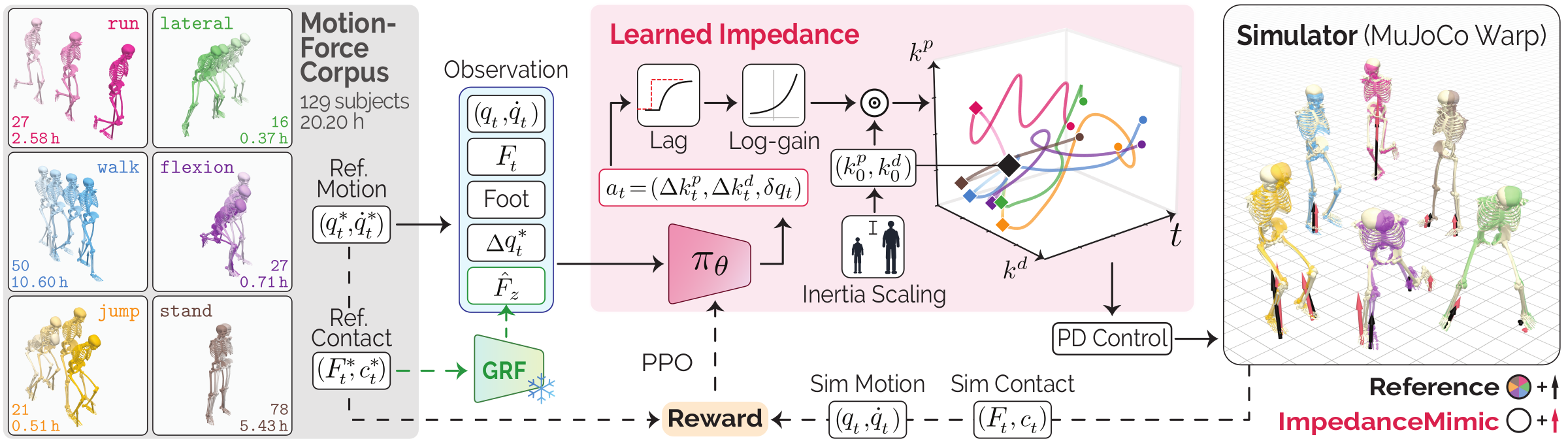
ImpedanceMimic is a reinforcement-learning policy for physics-based motion imitation that modulates the stiffness, damping and position setpoint of every joint. Trained on the motion and force-plate recordings of 129 people across six activities, it reproduces the movement and the contact forces together, and needs only motion at inference. The same policy transfers without retraining to unseen people, to activities withheld from training and to a simulated humanoid robot, and its gains encode motor state: stiffer under load, soft before the foot leaves the ground.
Video Abstract
One policy, six activities, 130 bodies
Joint angles and vertical force: reference (black) vs. ImpedanceMimic (red).
ImpedanceMimic (bone) on the reference (ghost). Forces: measured (black), simulated (red).
Learned stiffness kp vs. damping kd per joint; black ◆ = nominal gains.
Gains that encode motor state
The policy is free to set stiffness and damping at every joint and every instant. What it learns follows the state of the movement: stiffer under load, and softer before the foot leaves the ground.
Gains over one movement cycle
contact Median over the cycles of one task per activity, on held-out clips (policy of seed 0). A value of 1 is the nominal gain that Fixed-PD holds. Contact is mapped to the first 60 % of the cycle. Move over the plot to read the values, and click an activity to highlight it everywhere on this page.
Stiffness follows load
A map of the gains
Each point is one cycle, placed by the two main components of its hip, knee and ankle gain trajectories (57 % of the variance). Activities separate, and cycles of the 22 unseen people fall on the same clusters.
Method
Results
Citation
@misc{impedancemimic2026,
  title  = {ImpedanceMimic: Learned Impedance as Action Space for Force-Accurate Motion Imitation},
  author = {Anonymous Authors},
  year   = {2026},
  note   = {Under review}
}
Acknowledgements
Omitted for double-blind review.